Dreams feel deeply personal, yet they are shaped by something much larger than the individual mind. When you wake from a vivid dream—confused, inspired, or emotionally moved—you may wonder why it meant what it did to you. The answer often lies not only in psychology or spirituality, but in culture.
Across the world, societies interpret dreams in profoundly different ways, reflecting shared beliefs about the soul, destiny, fear, and healing. Understanding cultural differences in dream interpretation opens a powerful doorway into self-awareness, empathy, and spiritual growth.
Overview: Dreams, Emotions, and Spiritual Meaning Across Cultures
Dreams are universal, but their meanings are not. Culture influences how we understand symbols, emotions, and even the purpose of dreaming itself.
In some traditions, dreams are messages from the divine. In others, they are expressions of the unconscious mind processing daily life. Many cultures blend spiritual insight, emotional truth, and psychological meaning into dream interpretation.
At their core, dreams reflect:
- Emotional states we may not consciously acknowledge
- Spiritual beliefs about the soul, ancestors, or higher guidance
- Cultural symbolism passed down through generations
Symbolism Through a Cultural Lens
How Symbols Change Meaning Across Cultures
A single dream symbol can carry opposite meanings depending on cultural context.
- Snakes
- Western cultures: fear, temptation, danger
- Eastern cultures: wisdom, rebirth, spiritual power
- Water
- Some cultures: emotional cleansing and renewal
- Others: chaos, uncertainty, or loss of control
- Death in dreams
- Western psychology: endings or transformation
- Indigenous traditions: communication with ancestors or spiritual initiation
These differences show that dream symbolism is not universal, but culturally shaped.
Cultural Views on the Purpose of Dreams
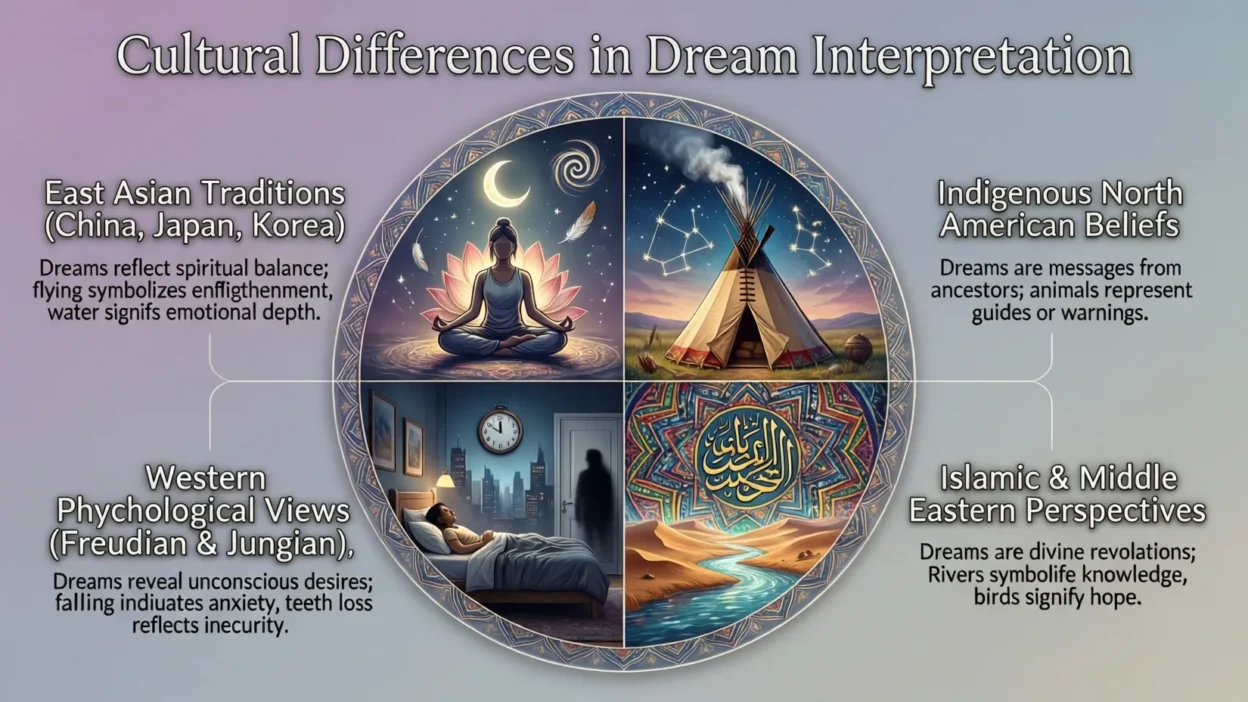
Western Psychological Perspective
In many Western societies, dreams are seen as:
- Reflections of personal psychology
- Expressions of unresolved emotions or desires
- Messages from the subconscious mind
Indigenous and Tribal Cultures
Dreams are often viewed as:
- Sacred journeys
- Messages from ancestors or spirit guides
- Tools for healing and community guidance
Eastern Spiritual Traditions
Dreams may represent:
- Illusions of the mind (as in Buddhism)
- Indicators of spiritual imbalance or karma
- Stages of consciousness and awakening
Personal Growth Themes in Cultural Dream Interpretation
Across cultures, dreams often guide personal development, though the methods differ.
Common growth themes include:
- Self-awareness through symbolic reflection
- Emotional healing via confronting fears or trauma
- Spiritual alignment with life purpose or destiny
In collectivist cultures, dreams may emphasize community harmony, while individualistic cultures focus on personal identity and self-expression.
Different Dream Scenarios Across Cultures
Being Chased
- Western interpretation: avoidance, anxiety, stress
- African and Indigenous views: spiritual imbalance or ignored calling
Flying
- Western: desire for freedom or escape
- Eastern: spiritual elevation or detachment from ego
Losing Teeth
- Western: fear of aging or loss of control
- Asian cultures: concern about family or communication breakdown
Gradual Realization vs. Sudden Reaction in Dreams
Gradual Realization
In some cultures, understanding unfolds slowly:
- Dream meanings emerge through meditation or ritual
- Emphasis on patience and reflection
- Seen as a spiritual initiation process
Sudden Reaction
Other cultures value immediate insight:
- Dreams deliver clear warnings or instructions
- Quick emotional response is encouraged
- Often associated with prophetic or intuitive traditions
Both approaches honor different relationships with intuition and consciousness.
Freudian Interpretation Across Cultures
Sigmund Freud viewed dreams as:
- Expressions of repressed desires
- Often rooted in childhood or instinctual drives
While influential in Western thought, Freudian interpretation may feel limiting in cultures that:
- Emphasize collective symbolism
- View dreams as spiritual rather than sexual or personal
Still, Freud’s work helps explain how unconscious emotions influence dream imagery worldwide.
Jungian Interpretation and Cultural Archetypes
Carl Jung expanded dream interpretation by introducing:
- Universal archetypes (the hero, shadow, mother, trickster)
- The collective unconscious, shared across humanity
Jungian theory aligns closely with cultural dream traditions, as many societies recognize recurring symbolic figures that transcend time and geography.
Energy-Based and Spiritual Interpretations
Many cultures believe dreams reflect energy flow within the body and spirit.
Examples include:
- Chakra imbalances showing up as specific dream imagery
- Dreams as astral travel or soul journeys
- Emotional blockages manifesting symbolically
These interpretations view dreams as energetic diagnostics, not just mental events.
Causes and Triggers of Dreams Across Cultures
Dreams are influenced by both universal and culture-specific triggers:
- Emotional stress or trauma
- Major life transitions
- Spiritual practices (fasting, prayer, meditation)
- Cultural rituals and belief systems
Some cultures intentionally induce dreams for guidance or healing.
Scientific Perspective: REM Sleep and Emotional Processing
From a scientific standpoint, dreams occur primarily during REM (Rapid Eye Movement) sleep.
Research suggests dreams help with:
- Emotional regulation
- Memory consolidation
- Processing fear, joy, and unresolved experiences
Science complements cultural wisdom by showing that dreams are essential for mental and emotional health, even if meanings differ.
Reflection Tips for Interpreting Dreams Mindfully
To honor both cultural insight and personal meaning:
- Dream journaling: Write immediately upon waking
- Mindfulness practices: Observe emotions without judgment
- Cultural research: Explore your ancestral or spiritual traditions
- Symbol comparison: Reflect on what symbols mean to you
Dream interpretation is most powerful when it blends inner intuition with cultural awareness.
FAQ: Cultural Differences in Dream Interpretation
Are dream meanings universal?
No. Dream meanings vary widely based on cultural beliefs, symbolism, and spiritual frameworks.
Can one dream have multiple interpretations?
Yes. Dreams often carry psychological, spiritual, and cultural layers simultaneously.
Which interpretation is correct?
The most meaningful interpretation is the one that resonates emotionally and supports personal growth.
Do cultural beliefs affect dream content?
Absolutely. Culture shapes how the mind organizes symbols and emotions during dreams.
Should I follow cultural or psychological interpretations?
Ideally, integrate both for a balanced and insightful understanding.
Mindful Conclusion
Dreams are not just nighttime stories—they are reflections of who we are, where we come from, and how we understand reality. Exploring cultural differences in dream interpretation deepens compassion, expands spiritual awareness, and honors the diversity of human experience.
Whether viewed through psychology, spirituality, or science, dreams invite us to listen more closely to the quiet wisdom within.