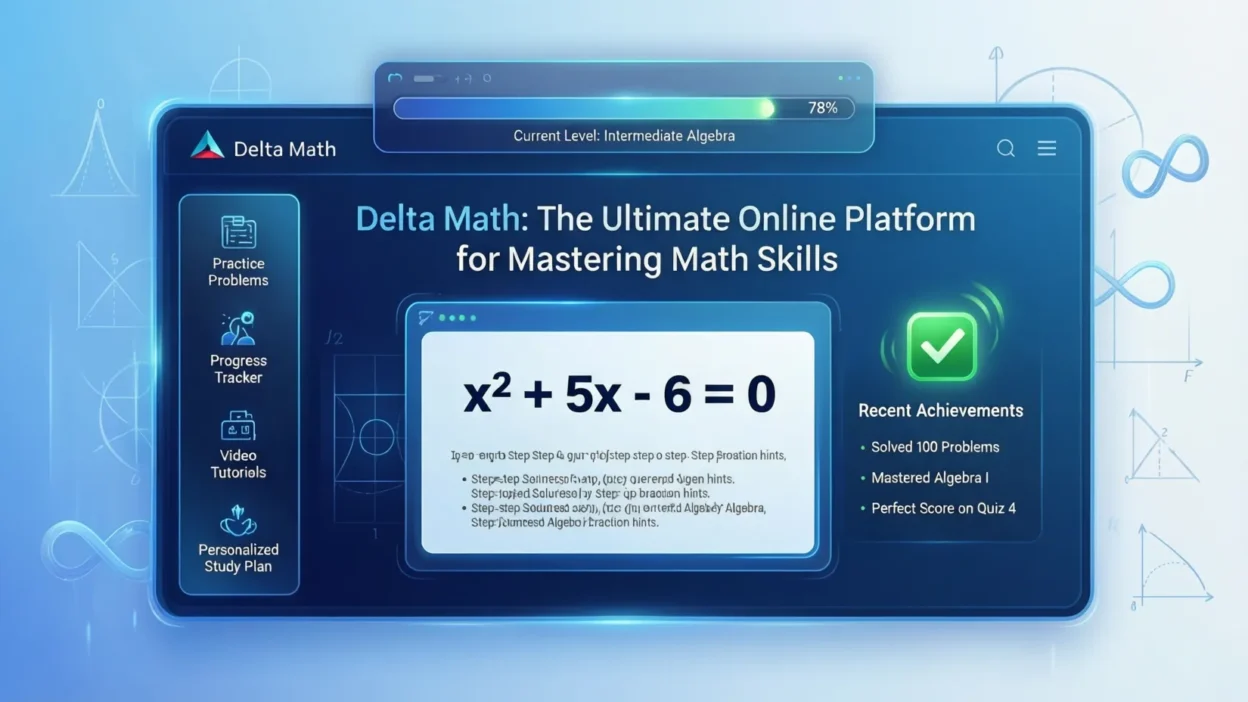
In today’s digital learning era, students need more than just textbooks to excel in mathematics. Delta Math has emerged as one of the most effective online platforms designed to help students practice, understand, and master a wide range of math concepts. Whether you’re struggling with algebra, geometry, trigonometry, or calculus, Delta Math offers interactive problem sets, instant feedback, and personalized learning pathways to make math engaging and accessible.
Not only does Delta Math help students build confidence and sharpen their problem-solving skills, but it also provides teachers with the tools to assign, track, and assess student performance effortlessly. From homework practice to exam preparation, the platform is tailored to meet the needs of learners at different levels. In this comprehensive guide, we’ll explore everything you need to know about Delta Math—including its features, benefits, tips for success, and much more.
What is Delta Math?
Delta Math is an innovative online math practice platform designed to help students strengthen their skills, improve problem-solving abilities, and achieve academic success. Unlike traditional worksheets, Delta Math offers interactive exercises that adapt to each student’s level, making learning both effective and engaging. The platform covers a wide range of math topics, from basic arithmetic and algebra to geometry, trigonometry, calculus, and statistics, catering to middle school, high school, and even advanced learners.
One of Delta Math’s unique features is its step-by-step feedback system. When students solve problems, they receive immediate guidance on mistakes, allowing them to understand concepts rather than just memorizing answers. This feature encourages self-paced learning and helps students gain confidence in challenging topics.
Delta Math is also widely used by teachers for assignments, quizzes, and skill assessments. Educators can track student progress, assign specific practice sets, and identify areas where learners may need extra support. For students, the platform transforms math practice into a dynamic and interactive experience, replacing the monotony of traditional homework with an enjoyable, gamified approach.
In the following sections, we’ll dive deeper into how Delta Math works, its features, benefits, and tips for maximizing success, giving you a complete guide to using this powerful online math tool.
How Delta Math Works
Using Delta Math is simple, yet its platform is packed with features that make math practice effective and interactive. Whether you’re a student or a teacher, understanding how Delta Math works is key to getting the most out of it.
1. Account Setup
Students and teachers start by creating an account on the Delta Math website. Teachers can set up classrooms, assignments, and schedules, while students log in to access their personalized assignments and track their progress.
2. Navigating the Dashboard
Once logged in, the dashboard provides a clear overview of pending assignments, completed tasks, and performance statistics. Students can see upcoming deadlines and focus on areas that need improvement, while teachers can monitor the class’s overall progress.
3. Completing Assignments
Assignments in Delta Math are interactive. Students solve problems step by step, and the system provides instant feedback if an answer is incorrect. Multiple attempts are often allowed, encouraging learners to review mistakes and try again.
4. Submission and Feedback
After completing an assignment, students submit their work digitally. Delta Math automatically grades the problems and generates a detailed report. Teachers can review results, identify strengths and weaknesses, and provide additional guidance where necessary.
By combining interactive problem-solving, instant feedback, and detailed progress tracking, Delta Math ensures that students not only practice math but also truly understand each concept.
Key Features of Delta Math
Delta Math stands out as a top online math platform thanks to its powerful and student-friendly features. These tools are designed to make learning math more interactive, efficient, and enjoyable. Let’s explore some of the key features that make Delta Math a go-to platform for students and teachers alike:
1. Interactive Problem Sets
Delta Math provides dynamic exercises that allow students to solve problems step by step. Unlike static worksheets, these problems adapt to the student’s skill level, ensuring a personalized learning experience.
2. Immediate Feedback
One of the platform’s most valuable features is instant feedback. When a student answers incorrectly, Delta Math shows hints or explanations to help them understand the mistake, promoting conceptual understanding instead of memorization.
3. Skill Tracking and Progress Reports
Students and teachers can track performance in real-time. Detailed reports show which topics have been mastered and which require more practice, making it easier to focus on weak areas.
4. Customizable Assignments for Teachers
Teachers can create, assign, and schedule custom problem sets for their students. This flexibility helps align assignments with classroom lessons and curriculum standards.
5. Multiple Attempts and Hints
Students are often allowed to retry problems until they solve them correctly. Hints guide learning without giving away answers, encouraging critical thinking and problem-solving skills.
6. Gamified Learning Experience
With points, badges, and progress tracking, Delta Math makes practicing math fun, motivating students to stay consistent and engaged.
These features collectively make Delta Math a complete platform for learning, practicing, and mastering math, whether at home or in the classroom.
Benefits of Delta Math for Students
Delta Math is not just an online platform; it’s a powerful tool that transforms the way students learn and practice math. Here are the main benefits that make Delta Math a favorite among students:
1. Strengthens Problem-Solving Skills
By working through step-by-step problems and receiving instant feedback, students develop stronger analytical and critical thinking skills, which are essential for mastering math.
2. Personalized Learning Experience
Delta Math adapts to each student’s skill level, allowing learners to focus on areas where they struggle, while reinforcing topics they’ve already mastered.
3. Builds Confidence in Math
The platform encourages practice without fear of failure. With hints, retries, and gradual difficulty progression, students gain confidence as they see their skills improve.
4. Tracks Improvement Over Time
Students can monitor their own progress through detailed reports, identifying strengths and weaknesses, which helps them set realistic learning goals.
5. Prepares for Exams and Quizzes
Regular practice on Delta Math ensures that students are well-prepared for tests, as the platform provides exposure to a wide variety of problem types similar to school exams.
6. Engaging and Interactive Practice
The gamified experience—points, badges, and progress tracking—makes math practice more enjoyable, motivating students to practice consistently.
7. Encourages Independent Learning
With self-paced assignments and immediate feedback, students learn to work independently, developing discipline and time management skills that extend beyond math.
8. Covers a Wide Range of Topics
From basic arithmetic to calculus, Delta Math ensures that students have access to comprehensive practice across multiple math subjects.
9. Accessible Anytime, Anywhere
Delta Math is available online and via mobile apps, allowing students to practice anytime, whether at home, school, or on the go.
10. Reduces Math Anxiety
By giving students clear explanations and repeated practice, Delta Math helps reduce fear or stress associated with difficult math topics, promoting a positive learning mindset.
Benefits of Delta Math for Teachers
Delta Math isn’t just beneficial for students—teachers also gain powerful tools to manage math instruction more efficiently. Here’s how it helps educators:
1. Easy Assignment Creation
Teachers can create custom problem sets tailored to their classroom curriculum. This allows for assignments that match lesson plans and target specific learning objectives.
2. Automatic Grading
Delta Math automatically grades assignments, saving teachers hours of manual work. This feature ensures quick feedback for students and reduces teacher workload significantly.
3. Real-Time Progress Tracking
Educators can monitor student performance instantly, identifying which students are struggling and which topics need more review. This allows for data-driven instruction.
4. Skill Analysis and Insights
Detailed reports provide insights into class performance, skill mastery, and common mistakes, helping teachers adjust lessons to address problem areas.
5. Supports Differentiated Instruction
Delta Math allows teachers to assign different problems to different students based on skill level. This makes it easier to support both struggling and advanced learners in the same class.
6. Encourages Student Accountability
By tracking student submissions and progress, teachers can encourage responsibility and independent learning habits in their students.
7. Saves Time for Instruction
With automated grading, progress tracking, and pre-made assignments, teachers can spend more time teaching concepts rather than managing homework logistics.
8. Enhances Classroom Engagement
The interactive and gamified nature of Delta Math motivates students, creating a more engaged and participative classroom environment.
9. Integrates with Classroom Learning
Assignments can be aligned with in-class lessons, reinforcing what students learn during lectures and bridging gaps between theory and practice.
10. Accessible Anytime, Anywhere
Teachers can manage assignments, check progress, and provide feedback from any device, making classroom management more flexible and efficient.
Common Challenges Students Face on Delta Math
While Delta Math is a powerful tool for learning math, students may encounter a few challenges that can affect their experience. Being aware of these obstacles can help learners overcome them and succeed on the platform.
1. Difficult Problems Without Enough Hints
Some exercises, especially at higher levels, can be very challenging. Students may struggle if hints or explanations are limited, which can cause frustration.
2. Time-Limited Assignments
Certain assignments or quizzes on Delta Math have strict time limits, making it stressful for students who need extra time to solve problems carefully.
3. Technical Issues
Occasionally, students may experience login problems, page loading errors, or submission glitches, which can interrupt practice and learning.
4. Reliance on Self-Discipline
Delta Math is self-paced, requiring students to manage their time effectively. Without consistent practice, students may fall behind.
5. Difficulty With Advanced Topics
Some learners may find advanced topics like calculus or trigonometry challenging without supplementary guidance, leading to gaps in understanding.
6. Over-Reliance on Hints
Using hints excessively may prevent students from developing independent problem-solving skills, reducing long-term learning effectiveness.
7. Motivation Issues
Despite gamification, some students may lose motivation if they struggle with repeated incorrect attempts or difficult assignments.
8. Understanding Feedback
While Delta Math provides instant feedback, students may misinterpret suggestions, leading to repeated mistakes.
9. Limited Collaboration
Unlike classroom group work, Delta Math is mostly individual, so students may miss out on peer learning opportunities.
10. Internet Dependency
Since Delta Math is online, students without stable internet access may struggle to complete assignments consistently.
Tips to Maximize Delta Math Success
To get the most out of Delta Math, students need more than just logging in and completing assignments. By following these practical strategies, learners can boost their skills, improve accuracy, and enjoy the learning process.
1. Practice Consistently
Set aside dedicated time every day or week to work on Delta Math problems. Regular practice builds confidence and reinforces learning.
2. Use Hints Strategically
Hints are helpful, but avoid over-relying on them. Try solving problems independently first, then use hints to guide your understanding.
3. Review Mistakes Thoroughly
Take time to understand why an answer was wrong. Delta Math’s instant feedback can help identify gaps in knowledge and prevent repeating mistakes.
4. Set Personal Goals
Track your progress and set realistic goals, like completing a set number of problems daily or mastering specific topics each week.
5. Break Down Difficult Problems
For complex assignments, tackle problems step by step. Focus on understanding each part rather than rushing to the solution.
6. Engage With Teachers or Peers
If stuck, ask teachers or classmates for guidance. Delta Math is a learning tool, but collaboration can clarify challenging concepts.
7. Use the Mobile App for On-the-Go Practice
Delta Math’s mobile app allows students to practice anytime, anywhere, making it easier to fit learning into a busy schedule.
8. Track and Celebrate Progress
Regularly check your skill reports and celebrate milestones—this keeps motivation high and reinforces positive habits.
9. Combine with Other Learning Resources
Use textbooks, class notes, or online videos to reinforce concepts you find difficult on Delta Math.
10. Stay Patient and Persistent
Some topics take time to master. Persistence and patience are key to turning mistakes into learning opportunities.
11. Focus on Weak Areas First
Spend more time on topics where your performance is low to improve overall understanding and exam readiness.
12. Avoid Last-Minute Practice
Don’t cram before tests. Consistent, paced practice ensures better retention and understanding.
13. Utilize Step-by-Step Solutions
When available, review step-by-step solutions to understand problem-solving methods and techniques.
14. Challenge Yourself
Try bonus or advanced problems to push your limits and gain confidence in tougher topics.
15. Keep a Positive Mindset
Approach math with a growth mindset, seeing challenges as opportunities to learn rather than obstacles.
By following these tips, students can maximize the benefits of Delta Math and turn practice into mastery.
Delta Math for Different Math Topics
One of the reasons Delta Math is so popular is its ability to cover a wide range of math topics, making it suitable for students at different levels. Each topic comes with tailored problem sets and interactive exercises that help build understanding and mastery.
1. Algebra
Delta Math offers practice on equations, inequalities, functions, and polynomials. Students can solve problems step by step, get instant feedback, and strengthen their logical thinking and problem-solving skills.
2. Geometry
From shapes, angles, theorems, and proofs, Delta Math provides visual and interactive exercises that make geometry easier to understand. Students learn to apply formulas and reason spatially.
3. Trigonometry
Delta Math covers trigonometric functions, identities, and graphs, allowing learners to practice solving equations and visualize trigonometric concepts clearly.
4. Calculus
For advanced learners, the platform offers exercises in limits, derivatives, integrals, and optimization problems. Step-by-step feedback ensures that students grasp the underlying principles, not just the solutions.
5. Statistics and Probability
Delta Math includes data interpretation, probability rules, mean/median/mode, and combinatorics, helping students build analytical and critical thinking skills.
6. Mixed or Advanced Topics
Students can also practice mixed problem sets or enrichment exercises, which challenge them to apply multiple concepts in one problem, enhancing their overall mathematical reasoning.
Delta Math vs Other Math Platforms
With so many online math platforms available, students and teachers often wonder how Delta Math compares to alternatives like Khan Academy, IXL, or Mathletics. Here’s a detailed comparison to help understand its unique strengths and areas of advantage:
1. Personalized Practice
While platforms like Khan Academy provide exercises, Delta Math adapts problem sets to individual skill levels more dynamically, helping students focus on their weak areas.
2. Step-by-Step Feedback
Delta Math provides immediate, detailed feedback for incorrect answers, guiding students through mistakes, whereas some platforms only indicate right or wrong.
3. Teacher-Centric Features
Unlike many free platforms, Delta Math allows teachers to create assignments, track progress, and analyze class performance, making it ideal for classroom integration.
4. Gamification and Engagement
Delta Math includes points, badges, and skill tracking, keeping students motivated, while other platforms may have limited gamified features.
5. Coverage of Topics
While Khan Academy and IXL cover a wide range of topics, Delta Math focuses deeply on high school and advanced math, including algebra, geometry, trigonometry, calculus, and statistics.
6. Flexibility and Mobile Access
Delta Math’s mobile-friendly interface allows anytime, anywhere practice, which some platforms lack in terms of smooth mobile experience.
7. Cost Considerations
Some platforms offer free access (like Khan Academy), while Delta Math may require teacher or school subscriptions, but it provides structured, classroom-ready tools in return.
In summary, Delta Math excels in interactivity, teacher integration, and step-by-step learning, making it a strong choice for students who want focused, skill-based math practice.
Delta Math Mobile App and Accessibility
Delta Math is designed to be accessible anywhere, anytime, making it easy for students to practice math on the go. Its mobile app and responsive website ensure a seamless experience across devices, allowing learners to stay consistent with their practice.
1. Mobile App Features
The Delta Math mobile app provides the same interactive problem sets as the desktop version. Students can:
- Complete assignments from their phones or tablets
- Receive instant feedback on answers
- Track their progress in real time
- Access hints and step-by-step solutions
2. Device Compatibility
Delta Math works on Windows, macOS, iOS, and Android, ensuring that students can access assignments from computers, tablets, or smartphones. This flexibility is perfect for home, school, or travel learning.
3. Accessibility Features
The platform is designed with accessibility in mind:
- Readable fonts and clean interface for easier navigation
- Keyboard navigation for students who may not use a mouse
- Visual aids and hints to support students with learning difficulties
4. Offline Considerations
While Delta Math is primarily online, some features allow students to prepare for assignments in advance. Consistent internet access is recommended to sync progress and submit assignments.
5. Benefits of Mobile Access
With mobile access, students can practice anywhere and anytime, helping them develop a habit of consistent learning. This is especially useful for busy schedules, after-school practice, or reviewing before exams.
Parental Involvement in Delta Math
Parents play a crucial role in helping students succeed with Delta Math. By staying engaged, they can monitor progress, encourage consistent practice, and provide guidance when needed.
1. Tracking Student Progress
Parents can review reports and scores to see how their child is performing. This helps identify strengths and areas that need improvement, allowing for targeted support.
2. Encouraging Consistent Practice
Regular reminders and structured study schedules help students stay disciplined and avoid last-minute cramming. Consistent practice ensures steady improvement and confidence building.
3. Supporting Difficult Topics
Parents can assist by explaining concepts or guiding their children when problems seem challenging. Using class notes or textbooks alongside Delta Math helps reinforce learning.
4. Celebrating Milestones
Acknowledging achievements, such as mastering a topic or improving scores, keeps students motivated. Rewards or praise for progress can boost confidence and engagement.
5. Avoiding Over-Intervention
While support is important, parents should avoid solving problems for their children. Delta Math is designed for self-paced learning, and independence is key to mastering skills.
6. Using Mobile and Desktop Access Together
Parents can ensure their children take advantage of both desktop and mobile platforms, allowing flexibility in study locations and maximizing practice time.
By staying involved without taking over, parents can enhance their child’s learning experience, ensuring Delta Math becomes a tool for skill mastery, confidence, and consistent practice.
Student Success Stories Using Delta Math
Many students have experienced significant improvements in their math skills through consistent use of Delta Math. These success stories highlight the platform’s ability to boost confidence, understanding, and academic performance.
1. Improved Grades
Several students report higher test scores and overall grades after regularly practicing on Delta Math. The step-by-step problem solving and instant feedback help them avoid repeating mistakes and master key concepts.
2. Increased Confidence in Math
Students who struggled with math often gain confidence as they see gradual improvement. Solving challenging problems and tracking progress builds a sense of achievement and self-belief.
3. Mastery of Weak Areas
Delta Math allows students to identify weak topics and focus on them. Many learners have improved in areas like algebra, geometry, and calculus, which were previously difficult.
4. Efficient Exam Preparation
Students who use Delta Math consistently find themselves better prepared for exams. Exposure to a variety of problem types and difficulty levels reduces test anxiety.
5. Positive Teacher Feedback
Teachers have noticed greater engagement and motivation in students who regularly use Delta Math. Class discussions and problem-solving skills improve alongside platform usage.
6. Success in Advanced Math Topics
Even students tackling calculus, trigonometry, or statistics have reported success, thanks to Delta Math’s detailed explanations and interactive problem sets.
7. Motivation Through Gamification
Points, badges, and progress tracking encourage students to stay consistent, turning practice into a fun and rewarding experience.
These stories demonstrate that with consistent effort and effective use, Delta Math can transform a student’s math journey, making learning both productive and enjoyable.