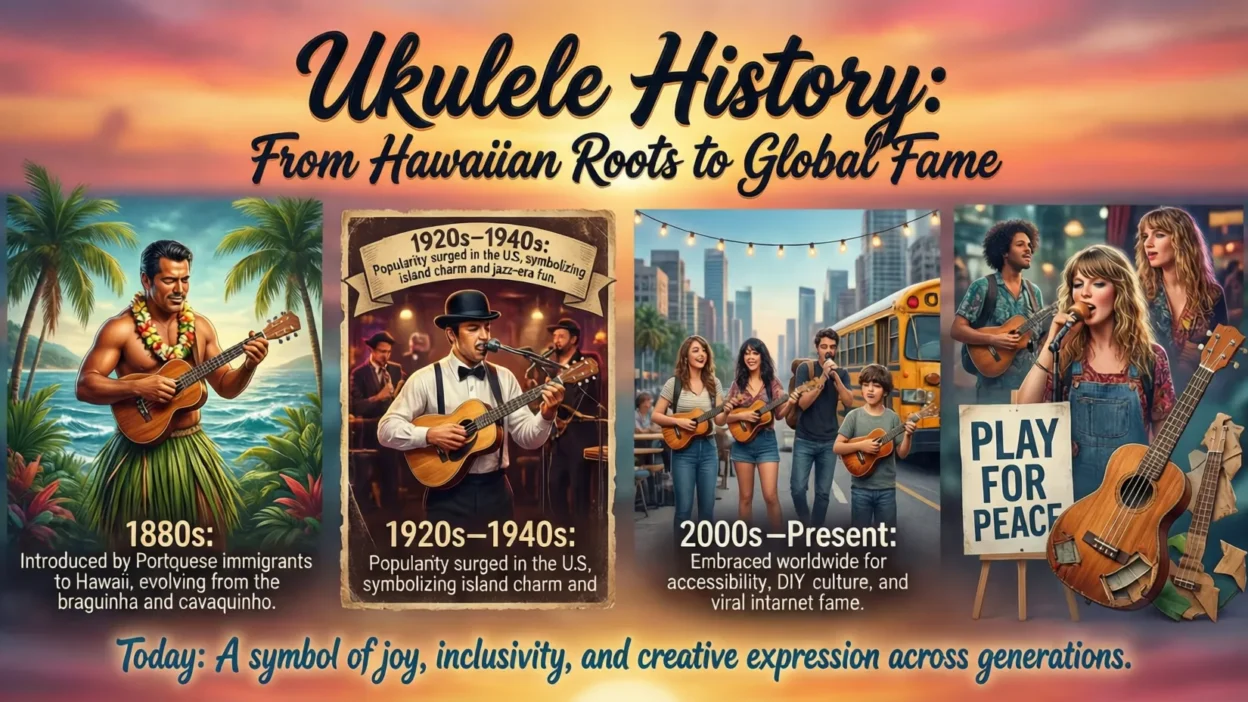
The ukulele, with its cheerful, melodic tones, is more than just a small, four-stringed instrument—it is a symbol of joy, culture, and musical creativity. Its journey began in Hawaii during the late 19th century when Portuguese immigrants brought the machete, a small guitar-like instrument. Hawaiian musicians embraced it, transforming its sound and playing style, creating the instrument we now recognize as the ukulele. Over time, the ukulele traveled beyond the islands, gaining popularity in the United States and eventually capturing audiences worldwide.
From traditional Hawaiian music to contemporary pop, viral performances, and music education, the ukulele has made a lasting impact on global culture. In this article, we’ll explore the ukulele’s fascinating origins, evolution, cultural significance, famous players, and its continuing influence in the world of music today.
Origins of the Ukulele
The ukulele has a fascinating beginning that connects both Europe and Hawaii. Its roots trace back to the Portuguese machete, a small guitar-like instrument brought to Hawaii by Portuguese immigrants from Madeira and Cape Verde in the late 19th century. When these settlers arrived in the islands, local Hawaiians were fascinated by the instrument’s bright, cheerful sound.
Hawaiian musicians quickly adapted the machete, refining its shape, tuning, and playing style to suit their music. They named it “ukulele”, which roughly translates to “jumping flea” in Hawaiian, possibly inspired by the nimble movement of the player’s fingers.
Initially, the ukulele was used primarily in Hawaiian folk music and social gatherings, accompanying hula dances and traditional songs. Over time, its popularity grew beyond local communities, eventually becoming a key part of Hawaii’s cultural identity. This small, portable instrument had already begun its journey toward global recognition.
Key Points:
- Portuguese immigrants introduced the machete to Hawaii.
- Hawaiians adapted it into the ukulele with unique tuning and style.
- Name “ukulele” means “jumping flea.”
- Early use in folk music and hula performances.
Ukulele in Traditional Hawaiian Culture
Once the ukulele was embraced by Hawaiians, it quickly became more than just an instrument—it became a cultural icon. In traditional Hawaiian society, music played a central role in storytelling, ceremonies, and social gatherings, and the ukulele fit perfectly into this vibrant cultural landscape.
The instrument was commonly used to accompany hula dances, enhancing the rhythm and emotion of performances. Its bright, melodic sound complemented chants and traditional songs, creating an atmosphere of joy and celebration. Families would gather to play music together, and learning the ukulele often became a rite of passage for children, passing musical traditions from one generation to the next.
Hawaiian craftsmen also began experimenting with ukulele designs, refining its shape, size, and materials to improve tone and playability. Over time, the ukulele became a symbol of Hawaiian pride, representing the islands’ creativity, community spirit, and love for music.
Key Points:
- Central to storytelling, ceremonies, and social gatherings.
- Commonly accompanied hula dances and traditional songs.
- Learning the ukulele was a generational tradition.
- Hawaiian craftsmen refined its design, creating unique tonal qualities.
- Became a symbol of Hawaiian pride and cultural identity.
Early Popularization in the United States
By the early 20th century, the ukulele had begun its journey beyond Hawaii, capturing the attention of mainland America. Tourists visiting the islands brought back recordings and instruments, sparking curiosity and excitement about this charming, portable instrument.
The Vaudeville era played a significant role in popularizing the ukulele. Performers incorporated it into comedy acts, musical shows, and theatrical productions, introducing its lively sound to wider audiences. Around the 1920s and 1930s, the “Ukulele Craze” swept the United States. Sheet music publishers, radio programs, and early Hollywood films promoted the instrument, making it a household favorite.
During this period, the ukulele became associated with fun, leisure, and easy music-making, appealing to beginners and seasoned musicians alike. Its small size and cheerful tone made it ideal for casual playing at home, parties, and public events. By the mid-20th century, the ukulele had firmly established itself as a beloved instrument across the U.S., setting the stage for its global spread.
Key Points:
- Tourists introduced the ukulele to mainland America.
- Vaudeville performers popularized it in shows and comedy acts.
- The 1920s–1930s “Ukulele Craze” brought it to homes nationwide.
- Featured in sheet music, radio, and Hollywood films.
- Became a symbol of fun, leisure, and approachable music.
Iconic Ukulele Players and Innovators
Throughout its history, the ukulele has been shaped and popularized by a number of legendary musicians who showcased its versatility and charm. These performers not only mastered the instrument but also inspired millions to pick up the ukulele themselves.
One of the most famous early players was George Formby, a British entertainer known for his comedic songs and fast, rhythmic strumming. His performances in the 1930s and 1940s introduced the ukulele to audiences far beyond Hawaii. In Hawaii, Israel Kamakawiwoʻole, affectionately called “Iz,” became an international icon with his soulful rendition of “Somewhere Over the Rainbow.” His gentle voice combined with the ukulele’s warm tones brought global attention to Hawaiian music. Another memorable figure was Tiny Tim, who brought the ukulele into American pop culture during the 1960s, often performing quirky songs on television and stage.
Modern players like Jake Shimabukuro and Eddie Kamae have further expanded the ukulele’s possibilities, using innovative techniques and blending genres like jazz, rock, and classical. Their creativity continues to inspire new generations of musicians worldwide.
Key Points:
- George Formby popularized the ukulele in Britain and worldwide.
- Israel Kamakawiwoʻole brought global attention to Hawaiian ukulele music.
- Tiny Tim introduced the ukulele into American pop culture.
- Jake Shimabukuro and Eddie Kamae innovated modern playing techniques.
Evolution of Ukulele Design
The ukulele has undergone significant design evolution since its introduction to Hawaii. Originally modeled after the Portuguese machete, early ukuleles were small, simple, and made from local woods. Hawaiian craftsmen experimented with different shapes and sizes to improve sound quality, resulting in the variety of ukulele types we know today.
The four main types—soprano, concert, tenor, and baritone—each offer unique tonal qualities and playability. The soprano, the smallest, produces the classic bright ukulele sound, while the baritone, larger in size, has a deeper, guitar-like tone. Innovations also include changes in materials, from traditional koa and mahogany woods to modern laminated woods, as well as the use of nylon, gut, or fluorocarbon strings.
In recent years, electric and hybrid ukuleles have emerged, allowing amplification and experimentation with different music genres. Even small adjustments, such as the shape of the body, bracing patterns, and string arrangement, have a noticeable impact on sound. These innovations have made the ukulele more versatile and appealing to musicians worldwide, while still retaining its charming, cheerful tone.
Key Points:
- Early ukuleles made from local Hawaiian woods, based on the Portuguese machete.
- Four main types: soprano, concert, tenor, baritone.
- Materials evolved from koa and mahogany to modern laminated woods.
- Strings innovations: nylon, gut, fluorocarbon.
- Electric and hybrid ukuleles expanded versatility.
- Design adjustments enhance tone and playability.
Ukulele in Global Music
The ukulele’s appeal quickly spread beyond Hawaii and the United States, becoming a global phenomenon. Its portability, cheerful sound, and simplicity made it a favorite for musicians and enthusiasts around the world.
In Japan, the ukulele gained immense popularity in the 20th century, inspiring dedicated clubs, music schools, and even festivals. European countries, particularly the United Kingdom and Germany, embraced the instrument through folk music and contemporary bands. Today, the ukulele is found on every continent, integrated into diverse music genres including pop, rock, jazz, and world music.
Global festivals and competitions celebrate the ukulele’s versatility, bringing together players of all ages and skill levels. Its presence in viral online videos, YouTube tutorials, and international performances has made it a cultural bridge, connecting musicians across different traditions and countries. The ukulele is no longer just a Hawaiian instrument—it has become a symbol of joy, creativity, and global musical unity.
Key Points:
- Ukulele gained popularity in Japan, Europe, and other parts of the world.
- Featured in folk, pop, rock, jazz, and world music.
- Global festivals and competitions celebrate its versatility.
- Viral online content helped spread awareness worldwide.
- Symbol of creativity, joy, and cultural connection.
Ukulele in Contemporary Music
Today, the ukulele enjoys a prominent place in contemporary music, far beyond its traditional Hawaiian roots. Artists across pop, indie, rock, and even hip-hop genres have embraced the instrument for its bright, uplifting tone and unique charm.
Viral online performances and YouTube tutorials have made the ukulele accessible to millions, inspiring beginners and seasoned musicians alike. Its small size and simple learning curve make it ideal for casual music-making, classroom instruction, and even music therapy. Pop artists often incorporate ukulele into recordings to add a cheerful, intimate feel, while indie bands use it to create unique, memorable sounds.
The ukulele has also appeared in movies, commercials, and social media content, further cementing its place in global pop culture. By combining tradition with modern innovation, the ukulele continues to connect audiences and performers, proving that a small instrument can have an enormous cultural impact.
Key Points:
- Used in pop, indie, rock, and hip-hop music.
- Viral online performances and tutorials boost accessibility.
- Popular in classrooms and music therapy programs.
- Adds a cheerful, intimate tone in recordings and live performances.
- Featured in movies, commercials, and social media, enhancing pop culture presence.
Ukulele in Contemporary Music
Today, the ukulele enjoys a prominent place in contemporary music, far beyond its traditional Hawaiian roots. Artists across pop, indie, rock, and even hip-hop genres have embraced the instrument for its bright, uplifting tone and unique charm.
Viral online performances and YouTube tutorials have made the ukulele accessible to millions, inspiring beginners and seasoned musicians alike. Its small size and simple learning curve make it ideal for casual music-making, classroom instruction, and even music therapy. Pop artists often incorporate ukulele into recordings to add a cheerful, intimate feel, while indie bands use it to create unique, memorable sounds.
The ukulele has also appeared in movies, commercials, and social media content, further cementing its place in global pop culture. By combining tradition with modern innovation, the ukulele continues to connect audiences and performers, proving that a small instrument can have an enormous cultural impact.
Key Points:
- Used in pop, indie, rock, and hip-hop music.
- Viral online performances and tutorials boost accessibility.
- Popular in classrooms and music therapy programs.
- Adds a cheerful, intimate tone in recordings and live performances.
- Featured in movies, commercials, and social media, enhancing pop culture presence.
Learning and Teaching the Ukulele
The ukulele has become one of the most beginner-friendly instruments in the world, making it popular among children, adults, and music enthusiasts of all ages. Its small size, lightweight design, and simple chord structures allow new players to quickly learn basic songs and build confidence in their musical skills.
In schools, the ukulele is widely used as a teaching tool to introduce students to music theory, rhythm, and ensemble playing. Many music educators appreciate how it encourages participation, creativity, and collaboration. Online tutorials, apps, and video lessons have further made learning the ukulele accessible globally, allowing beginners to progress at their own pace.
Additionally, the ukulele has found a place in music therapy programs, helping improve mental well-being, motor skills, and emotional expression. Its cheerful sound and easy playability make it ideal for fostering a love for music in learners of all backgrounds.
Key Points:
- Beginner-friendly due to small size and simple chords.
- Widely used in schools to teach music theory and rhythm.
- Online tutorials and apps make learning accessible worldwide.
- Promotes creativity, participation, and collaboration.
- Used in music therapy to improve mental well-being and motor skills.
Ukulele Festivals and Competitions
Ukulele festivals and competitions have played a major role in celebrating the instrument and connecting players from around the world. These events showcase the ukulele’s versatility, creativity, and cultural significance while bringing together enthusiasts of all ages and skill levels.
The Ukulele Festival Hawaii, founded in the 1970s, is the largest and most famous gathering of ukulele players. Musicians from around the globe travel to Hawaii to perform, learn, and celebrate Hawaiian culture through music. Similar festivals in Japan, Europe, and the United States highlight local talent and encourage cultural exchange, making the ukulele a truly global phenomenon.
Competitions at these festivals test skill, speed, and musical creativity, inspiring performers to push the boundaries of traditional ukulele playing. Beyond the competitive aspect, festivals also provide workshops, group performances, and opportunities to learn from expert players, fostering community and lifelong passion for the instrument.
Key Points:
- Ukulele festivals celebrate music, culture, and community.
- Ukulele Festival Hawaii is the world’s largest ukulele event.
- International festivals in Japan, Europe, and the U.S. showcase global talent.
- Competitions highlight skill, speed, and creativity.
- Workshops and group performances promote learning and collaboration.
Ukulele in Art and Media
The ukulele’s cheerful and versatile sound has made it a favorite instrument in art and media worldwide. It often appears in movies, television shows, commercials, and literature, symbolizing joy, relaxation, and cultural charm.
In film and TV, the ukulele is frequently used to create a lighthearted or nostalgic atmosphere. From classic Hollywood comedies to modern indie films, its distinctive tone adds personality and emotion to scenes. Musicians and composers also use it in soundtracks to evoke warmth and intimacy.
The ukulele has inspired visual artists, appearing in paintings, posters, and illustrations celebrating Hawaiian culture or music in general. Its presence in literature and music videos further reinforces its cultural significance. Iconic songs performed on the ukulele—such as Israel Kamakawiwoʻole’s “Somewhere Over the Rainbow”—have become timeless pieces of media, reaching audiences globally and solidifying the ukulele’s place in popular culture.
Key Points:
- Frequently used in movies, TV, and commercials.
- Evokes lighthearted, nostalgic, or intimate moods.
- Appears in visual art, posters, and illustrations.
- Iconic ukulele songs become global media phenomena.
- Strengthens the ukulele’s cultural significance and pop culture presence.
Cultural Symbolism of the Ukulele
Beyond its musical appeal, the ukulele holds deep cultural and emotional significance. In Hawaii, it represents joy, community, and creativity, often associated with hula, family gatherings, and celebrations. Its small size and cheerful tone embody a sense of lightheartedness and approachability, making it a symbol of relaxation and fun.
Globally, the ukulele has come to represent cultural connection and unity. Musicians from different countries and backgrounds use it to bridge traditions, blending Hawaiian roots with local music styles. In pop culture, it often evokes nostalgia and positivity, appearing in films, advertisements, and social media content to create an uplifting mood.
For many, the ukulele is more than an instrument—it is a tool for emotional expression, creativity, and social bonding. Its presence in music education, therapy, and festivals highlights its role as a cultural ambassador, spreading happiness wherever it is played.
Key Points:
- Symbol of joy, community, and creativity in Hawaii.
- Represents relaxation, lightheartedness, and approachability.
- Bridges cultures and connects global music traditions.
- Evokes nostalgia and positivity in pop culture.
- Used in music education, therapy, and social gatherings to foster connection.